
AEROPONICS
AEROPONICS
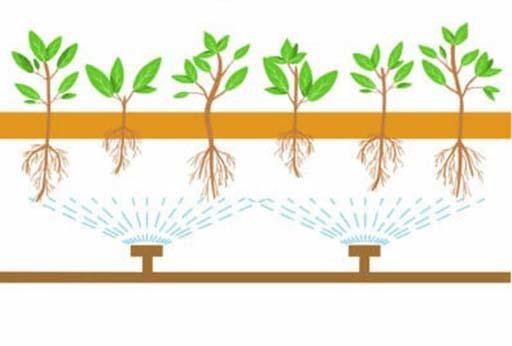
It is a method in which the plant roots are suspended in the air and the necessary nutrients are sprayed to the plant roots continuously or intermittently in the form of mist or steam. It provides water and fertilizer savings compared to other systems. Compared to other systems, the number of plants grown per unit area is two times higher.
The basic cultivation principle of aeroponics is to grow plants by atomizing or spraying the nutrient-rich water solution to the hanging roots and lower stem of the plant for the growth of hanging plants in a closed or semi-enclosed environment. Leaves and crown, often called canopy, extend upward. The roots of the plant are separated by the plant support structure. Usually, the closed cell foam is compressed around the lower stem and inserted into an opening in the aeroponic chamber, reducing labor and expense; trellis is used to suspend the weight of foliage and fruit for larger plants.
The environment is ideally kept free of pests and diseases so that plants grow healthier and faster than plants grown in the environment. However, because most aeroponic environments are not perfectly sealed to the outside, pests and disease can still be a threat.
Controlled environments improve plant development, health, growth, flowering and fruiting for any plant species and variety.
Due to the vulnerability of their root systems, aeroponics is often combined with conventional hydroponics, which is used as an emergency "crop saver" - a backup source of nutrition and water if the aeroponic apparatus fails
High pressure aeroponics is defined as the delivery of nutrients to the roots through 20-50 micrometer mist nozzles using a 550 kPa (80 psi) high pressure diaphragm pump
Disease Free Agriculture
Aeroponics can limit disease transmission as it reduces plant-to-plant contact and each spray blow can be germ-free. In soil, aggregate or other environments, the disease can spread to the growth medium and infect many plants. In most greenhouses this solid media requires sterilization after each crop and in many cases is discarded and replaced with fresh, germ-free media. A distinct advantage of aeroponic technology is that if a particular plant becomes sick, it can be quickly removed from the plant support structure without disturbing or infecting other plants.
Basil grown from seed in an aeroponic system in a modern greenhouse was first obtained in 1986.
Due to the disease-free environment inherent in aeroponics, many plants can be grown at a higher density (plants per square metre) compared to more traditional cultivation methods (hydroponic, soil and Nutrient Film Technique [NFT]). Commercial aeroponic systems include equipment features that accommodate the expanding root systems of the crop.
The researchers described aeroponics as "a valuable, simple and rapid method for the preliminary screening of genotypes for resistance to specific seedling blight or root rot."
The insulating nature of the aeroponic system allowed to avoid the complications encountered when studying these infections in soil culture.



©2022 GardeneryHouse Her Hakkı Saklıdır.